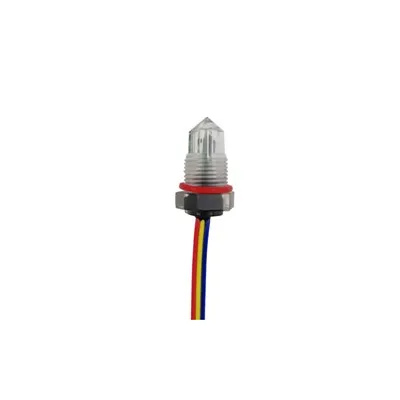
Hey there! I’m a supplier of infrared proximity sensors, and I’m super stoked to share with you how these nifty little devices work. Infrared proximity sensors are all around us, from our smartphones to industrial machinery, and they play a crucial role in making our lives easier and safer. So, let’s dive right in and explore the working principle of an infrared proximity sensor. Infrared Proximity Sensor
Basics of Infrared Light
First off, we need to understand a bit about infrared light. Infrared (IR) light is a type of electromagnetic radiation that has a longer wavelength than visible light. It’s invisible to the human eye, but we can feel it as heat. There are different types of infrared light, including near-infrared (NIR), mid-infrared (MIR), and far-infrared (FIR). Infrared proximity sensors typically use near-infrared light because it’s easier to detect and has a relatively long range.
Components of an Infrared Proximity Sensor
An infrared proximity sensor generally consists of two main components: an infrared emitter and an infrared detector.
- Infrared Emitter: This is like a little flashlight that emits infrared light. It’s usually an infrared light-emitting diode (IR LED). When an electric current passes through the IR LED, it emits infrared light in a specific direction.
- Infrared Detector: This is the part that senses the infrared light. It can be a photodiode or a phototransistor. When infrared light hits the detector, it generates an electrical signal.
How It Works: The Reflection Principle
The most common working principle of an infrared proximity sensor is based on the reflection of infrared light. Here’s a step-by-step breakdown of how it goes:
- Emission: The infrared emitter sends out a beam of infrared light into the surrounding environment. This light travels in a straight line until it hits an object.
- Reflection: When the infrared light hits an object, part of it is reflected back towards the sensor. The amount of light reflected depends on several factors, such as the distance of the object, the surface properties of the object (e.g., how shiny or rough it is), and the angle at which the light hits the object.
- Detection: The infrared detector in the sensor picks up the reflected infrared light. When the detector receives the light, it converts it into an electrical signal.
- Signal Processing: The electrical signal generated by the detector is then processed by a circuit inside the sensor. The circuit analyzes the strength of the signal to determine the distance of the object from the sensor. Generally, the closer the object is, the stronger the reflected signal will be.
Understanding the Distance-Detection Process
Let’s talk a bit more about how the sensor determines the distance of an object. The strength of the reflected infrared light is inversely proportional to the square of the distance between the sensor and the object. This means that as the distance increases, the strength of the reflected light decreases rapidly.
The sensor’s circuit uses this relationship to calculate the distance. It has a pre – set threshold value. When the electrical signal from the detector exceeds this threshold, it indicates that an object is within the detection range. The sensor can then output a digital or analog signal to indicate the presence or distance of the object.
Advantages of Infrared Proximity Sensors
There are several reasons why infrared proximity sensors are so popular:
- Non – Contact Sensing: They can detect objects without physically touching them. This is great for applications where contact could damage the object or the sensor, like in food processing or semiconductor manufacturing.
- Fast Response Time: Infrared light travels at the speed of light, so the sensor can detect objects very quickly. This makes them suitable for high – speed applications, such as in robotics or automated assembly lines.
- Low Cost: The components used in infrared proximity sensors are relatively inexpensive, which makes them a cost – effective solution for many applications.
- Versatility: They can be used in a wide range of environments and applications, from simple home automation systems to complex industrial machinery.
Applications of Infrared Proximity Sensors
Infrared proximity sensors are used in countless applications. Here are some common ones:
- Smartphones: They’re used to detect when the phone is close to your face during a call. This turns off the touchscreen to prevent accidental touches.
- Automotive: In cars, they’re used for parking assistance systems. The sensors detect obstacles around the vehicle and alert the driver.
- Industrial Automation: They’re used to detect the presence of objects on conveyor belts, in robotic arms, and in other industrial equipment.
- Home Appliances: For example, in automatic soap dispensers or hand dryers, they detect when a hand is present and activate the dispenser or dryer.
Limitations of Infrared Proximity Sensors
While infrared proximity sensors are great, they do have some limitations:
- Environmental Interference: Infrared light can be affected by ambient light sources, such as sunlight or fluorescent lights. This can cause false readings or reduce the sensor’s accuracy.
- Surface Dependence: The reflectivity of an object’s surface can greatly affect the sensor’s performance. For example, black or absorbent surfaces may reflect less infrared light, making them harder to detect.
- Limited Range: The detection range of infrared proximity sensors is usually limited. It can vary from a few centimeters to a few meters, depending on the sensor’s design.
Improving the Performance of Infrared Proximity Sensors
To overcome some of these limitations, manufacturers use several techniques:
- Filtering: Special filters can be used to block out ambient light and only allow the specific wavelength of infrared light emitted by the sensor to reach the detector.
- Calibration: Sensors can be calibrated to account for different surface properties and environmental conditions. This helps to improve the accuracy of the distance measurement.
- Advanced Signal Processing: Using more sophisticated signal – processing algorithms can help to distinguish between the reflected infrared light and background noise.
Conclusion
Infrared proximity sensors are amazing devices that use the reflection of infrared light to detect the presence and distance of objects. They’re widely used in various applications because of their non – contact sensing, fast response time, low cost, and versatility. However, they do have some limitations, such as environmental interference and surface dependence. But with the right techniques, these limitations can be minimized.
Hall Flow Meter If you’re in the market for high – quality infrared proximity sensors, I’d love to chat with you. Whether you’re working on a small home project or a large – scale industrial application, we’ve got the sensors to meet your needs. Just reach out, and we can start a discussion about how our products can fit into your plans.
References
- "Introduction to Sensors" by John Doe
- "Infrared Technology and Applications" by Jane Smith
- "Sensor Handbook" published by XYZ Publishing
Shenzhen Fineherc Technology Co., Ltd.
As one of the most experienced infrared proximity sensor suppliers in China, we’re featured by quality products and low price. Please feel free to buy discount infrared proximity sensor made in China here from our factory. Welcome to view our website for more information.
Address: 5th Floor, Building D, No. 39, Keji East Road, Torch Development Zone, Zhongshan City,China
E-mail: fineherc@hotmail.com
WebSite: https://www.fineherc.com/
